website stats
When I am Copyeditor General ...

Sunday

Even magvertorials will have real editors

Sometimes I have to go looking for examples of poor grammar, and sometimes they just land in my lap. The latter happened this week at the hair salon, where I discovered the magazine North End Scene, published by DePasquale Ventures, which owns a number of Italian food outlets.

The North End is not an area I know well. But as it's crammed with restaurants, bakeries and an increasing number of hip boutiques, I feel I should get a better sense of its contents. So I started to read.

Let's leave aside the fact that the best feature—interviews with Boston hotel concierges—is unrelated to the North End, and skip straight to the good stuff, in order of reverse heinousness.

First up, the conclusion to an article about buying cheese for a party:


First of all, if you're writing a food article, could you please check brand-name style? It's Ritz crackers (or, according to the Nabisco site, Ritz®).

Side note: the current online Ritz campaign has the most awesome wording on its opening page ever. If it's no longer up, don't worry: I saved a screenshot.

And what's with the punctuation here? That comma after "extraordinary" should really be a colon. And that's without considering whether the intended (upscale) audience for this mag would view buying a selection of imported cheeses as an "extraordinary" action.

Moving on. The next one's pretty long, and needs more space than this narrow layout allows, so please to read it here.

Oh, where to begin? The observation that "American women" (all of them, one imagines) "literally have their bank accounts hanging in their closets"? The writer's unchecked disagreement with the opinion of "any 'fashionista'"?

The line describing Valentino's 45-year career, followed by another noting that he's worked in the fashion industry for at least 48 years?

Or how about the way this writer re-invents "to profess" as a reflexive verb? Genius!

And for those who literally explode when they see misuse of "literally," there's more:


He literally lives in a lifestyle dictated by a fantasy world! And there are no normal people!

Why does it not surprise me that Alisa Kapinos, the writer of this article, is also the magazine's editor in chief?

But all of this pales into comparison with the simple beauty of one of the most egregious basic errors I have ever seen in print.

In a clumsy approximation of an upscale travel article—the type that says things like "we meet and greet beneath flowing waterfalls"—is this jaw-dropper:


What? WHAT? "The bow-shaped boat, what used to be the traditional means of transportation ..."

Copyeditor General's ruling: It's perfectly acceptable for a company that owns multiple restaurants to create a glossy magazine whose central goal is to promote those businesses. But as I've said many times before, you can't overlook the details.

If you're trying to brand yourself as a model of upscale sophistication, you have to hire people who can write and edit.

Or is North End Scene an accurate reflection of the dining experience at Bricco or Umbria: a veneer of style hiding poorly executed dishes?

Churches will have spellcheck

Remember how I said God would be in the details? Not yet, apparently.


Copyeditor General's ruling: Further down the street fron this church is another that has a sign that reads, "Never place a period where God has placed a comma."

Perhaps a more useful aphorism would be "Never place a sign inviting students to church if you don't know how to spell."

Wednesday

September 24 will be a national holiday

It's National Punctuation Day. Please celebrate responsibly, perhaps with a t-shirt:


or a song:

Friday

No one will fraternize with clients

I just happened to be browsing a Web communications job posting on the Tufts University careers site when I noticed this gem:


Copyeditor General's ruling: I'm not quite sure what kind of Web Comms office they're running up at Tufts, but they'd better keep their pants on.

Saturday

Spellcheck will be reserved for those who can spell

I used a calculator for the first time when I was six years old. This was the mid-'70s; pocket calculators were only just becoming affordable. I thought it was the greatest thing ever, and quickly turned it upside down to spell HELLO. Once I realized it was largely useless as a writing tool (what? You're supposed to use it for numbers? Ewww!) I moved on.

But I was still aware of the criticism that calculators would make people intellectually lazy; children would never learn to add (a vital life-skill, apparently).

And then we all got computers, and now not only do we not need to do math, but we also don't need to get up from the couch to meet people or buy groceries.

We can even stand on virtual street corners like crazy old men and rant endlessly about, say, the state of the English language.

Of course, while I love the efficiencies computers bring, I'm now old enough, and have read enough, to understand those '70s concerns. And I point an accusatory finger at spellcheck.

Why? Taylor Mali explains. (Contains mildly offensive language; you have been warned!)


Copyeditor General's ruling: I couldn't have pat it butter myself. And thanks to the lovely Sarah, who sent me the video and so is anointed Deputy of the Week!

Spelling will not be a political issue

I know you've probably seen this a billion times, but I couldn't resist:


Copyeditor General's ruling: I was hoping for bipartisan agreement on the use of dictionaries. Oh well.

Monday

The English will respect English

Point: Ken Smith, a lecturer in Criminology at Bucks New University in England (motto: We've Been a University Since 2007), wrote an op-ed piece for the August 7 Times Higher Education in which he argued that rather than repeatedly correcting students' spelling errors, teachers should accept them as variant spellings.

His reasoning? Most commonly misspelled words are of such ancient provenance that there's no reason for modern audiences to follow blind tradition:

We spell the word "February" the way we do only because it is taken from the Latin word februa, the Roman festival of purification. Similarly, the "correct" spelling of the word "Wednesday" comes from the Old English Wodnes daeg, or Woden's day. But why should we still pay homage today to a pagan god or a Roman festival of purification?

Counterpoint: The same magazine published responses to its annual call for egregious errors made in exams. As reported in The Guardian (oh, the irony!), British students wrote that "control of infectious diseases is very important in case an academic breaks out" and that "flirtation makes water safe to drink."

Copyeditor General's ruling: Sure, I can forgive the occasional typo; I can look the other way when I see uncommon words misspelled. Nobody's perfect, after all.

But when someone who is charged with teaching the next crop of professionals tries to argue that it's okay to half-ass the days of the week or the months of the year--because really, it's not as though you see them in writing very often, is it?--well, then we have a problem.

And if the exam examples are any indication, there's a lot of work to be done.

Newspapers won't confuse reggae singers with politicians' wives

Gotta love The Grauniad and their hey-it's-close-enough style of copyediting. From today's article about Barack Obama's family's appearance at the DNC:


Forgive my political ignorance, but did I miss something? I did a thorough search on the Googles, and this was the only Tippa I found.

Copyeditor General's ruling: Maybe that whole PMRC thing was a coverup for something more sinister ...

Update: Seems someone noticed the error; Tippa is out and Tipper is in. Phew!

Saturday

T shirt companies will not worry me

After much consideration, I decided that the one thing missing from this blog was merchandise: some way for the Copyeditor General's legions of supporters to demonstrate their love of good grammar. So I started checking out online custom merchmongers to see what was available.

But I only got as far as Spreadshirt. And then I had to stop. Because I was reminded of what's really important.


Um, what? Eisenhower was many things, but fashion designer was not one of his best-known traits. And while there is at least one example of a kid-size campaign shirt, I highly doubt that Ike's win over Adlai Stevenson in 1952 (not '53, Spreadshirt fact-checkers!) came down to little Billy's decision to wear it to the fishin' hole.

Okay, slight distraction. Back to the merch search. What, exactly, is Spreadshirt? Let's check their "About Us" page:

"Spreadshirt makes it possible for private and commercial internet site operators to market their homepages quickly, simply, and independently. Internet site operators can create an online shop with individually created products and connect it with their homepage within minutes."

Internet site operators? When was this written, 1996? And why are we only marketing the homepage? What are all the other pages on my site, electronic chopped liver?

"To operate a Spreadshirt shop, you just need Internet access, your own designs or logo, and to market your shop online."

Don't you love how easy it all sounds? Yep, just log on and use your in-depth knowledge of online marketing! Weren't we all born with that?

Okay, pop quiz: when you think about successful internet businesses, what names come to mind? Google, eBay, DoubleClick? Nay, I say thee! Nay!

"Spreadshirt is one of the most successful internet companies of the past few years."

Two hundred and fifty employees, they have! Look out, Yahoo!

From their mission statement:

"We want to build the best possible online create-buy-experience for everyone from Homer Simpson to Salvador Dalí."

Well, good luck with that. I hate to break it to you, Spreadshirt, but one is a cartoon character and the other left us in 1989. Neither will be ordering from you in the foreseeable future.

"We want to be a fun and inspiring place to work, where integrity, delivery, and innovation reigns."

Which one? If they all reign, they need a plural verb, dears.

"There is no limit to what your imigination can do."

True: there is no limit to what we can imigine.

Copyeditor General's ruling: I have nothing against Germans. Seriously, I don't: I studied the language for five years. I love their Riesling, their Stollen and the fact that The Hoff has somewhere else to go.

But the same goes for them as for the Japanese, Peruvian-Canadians, Texans and Steven Seagal: when your website is the face of your business, you need to make sure your content is flawless. If you're wrong about easily verifiable facts, and you don't check spelling, how well will you do with my order?

Olympians will try to win. Period.

I can't watch the Olympics. I just can't. Sure, I love the running around and the jumping and the splashing. But whenever the announcers start to discuss the essential aim of the participants' actions, I have to turn away. Because eventually they'll use That Verb.

To medal.

I know, I know; it's largely accepted now. It has weasled its way into speech and hooked itself into that particularly creative and forgiving (read: lazy) area of communications we call sports journalism, and now we see it everywhere:


One could clearly make a case for the verb's legitimacy. There's even a linguistic term that describes this kind of thing: anthimeria, or the use of one type of word as if it were another (e.g. a noun used as a verb). Shakespeare and Milton did it all the time.

I should make clear that it's not the practice of word-use substitution that bugs me: it's purely, simply, exquisitely That Verb. It's unnecessary. It's vapid. Again, it's lazy.

And yes, it takes longer to say "he'd like to finish within the top three" or "she hopes to win either gold, silver or bronze" or "he expects to be one of the guys with the flowers and the crying and the national anthem and stuff."

I wonder, though, whether there's a more culturally telling reason for the use and acceptance of this particular word choice: it makes the goal of the action the verb. It turns the symbol of achievement into the entire experience; it makes the destination the journey. It's no longer about participation: it's about winning, period.

And don't even get me started on the use of "winningest."

Copyeditor General's ruling: If this is an acceptable way of referring to aspirations and aquisitions, why limit it to sport? Why not use it in other circumstances?

I haven't had lunch yet, but I expect to sandwich soon.

Our offer was accepted, so it looks like we'll house by the end of the month.

She went into premature labor and surprised everyone by babying this morning.

Both McCain and Obama are hoping to president in November.

Okay, your turn: hit me with your best/worst example of anthimeria!

Sunday

Eels will not be party animals

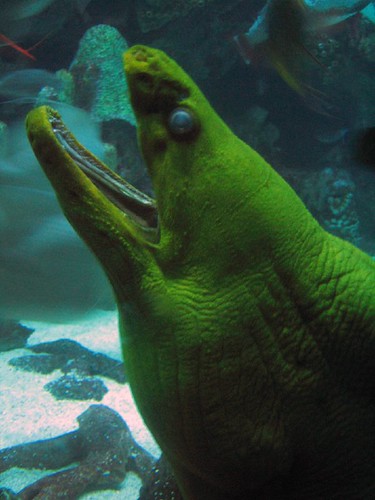
Last week we went to the New England Aquarium, whose main attraction is the four-story tropical ocean tank, in which swim turtles, sharks, sting rays and all manner of brightly colored fish.

And also this:


Handsome fella, no? He's a moray, and there are two, or maybe three, in the tank. I'm not quite sure of the exact number because we never saw them together; they seemed to be solitary creatures.

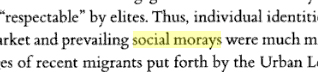
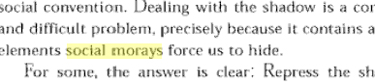
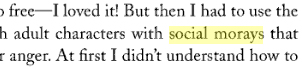
Which is why I was surprised to find this:


and this:


and this:


and this:


All of which lead me to believe that the morays we saw were just spending a little alone time before getting together for a rousing game of bridge.

Copyeditor General's ruling: Another case of those darned confusing homophones, which we've covered here before. My instinct is to blame the blessing/curse of the Internets, where anyone can post anything without going through an editorial gatekeeper.

But not this time. All the above came from books. Actual, real, printed (and allegedly edited and proofread) books. You can see a few dozen more examples here. Shocking!

The word for the rules and social customs of a culture, while pronounced with two syllables, is spelled
mores. But:

If you see a big eel
And its face makes you squeal

That's a moray.

(Sorry.)

No one will paint on the roof of my mouth

You may be familiar with my other blog, in which I write about food. I'm also learning, slowly but surely, how to take better photographs of the dishes I create/consume.

But as I recently discovered, it's not enough that I use two forms of creativity to capture my epicurean events. According to a wealth of evidence, I should be painting them as well.


Copyeditor General's ruling: Not only do I need to dig up my ancient paintbox and start blending pigments, I should also allow my color-mixing surface to be pushed, prodded, stretched and generally abused.

This is not a particularly palatable thought; in truth, it leaves rather a sour taste on my palate.

Saturday

Yogurt will not be duplicitous

One lunchtime last week, my boss Caren came over to my desk, bearing a pot of Greek yogurt.

"I've got one for you!" she said, triumphantly. "Take a look at this."


Yep, looks like yogurt.

"Now read the description."


Copyeditor General's ruling: There's nothing wrong with being a math-averse copywriter; I count myself in that number. But when you're dealing with percentages, it's useful to understand what "0% non fat" means.

Of course, this could just be the world's most unhealthy yogurt.

And congrats to Caren, partly on her upcoming nuptials, but most importantly on being Copyeditor General's Deputy of the Week!

Thursday

There will be educated people in Harvard Square

When you think Harvard Square, what images come to mind? Okay, probably one of the following:
  • Hordes of tourists in matching crimson sweatshirts from the cart in the subway station;
  • Suburban a-haaaal-turrrnative teens practicing skateboard moves (oops, sorry, they've moved on to parkour now) in the Pit;
  • An inexplicable line of people waiting to get into the decidedly underwhelming Border Cafe;
  • Rami Salami
Okay, yes, those are all true. However, the answer we're looking for: Disciplined intellectuals thriving in a world of high educational expectations, with examples of academic excellence and exactitude at every turn.

Right? Harvard, right? Three hundred and fifty years of graduating people like JFK, T.S. Eliot, Benazir Bhutto, Margaret Atwood, W.E.B Du Bois, Robert Benchley? Shouldn't that somehow rub off on the rest of the population?

Maybe the educational vibes just don't make it as far as the offices of harvardsquare.com.


Copyeditor General's ruling:I suppose I shouldn't have such high expectations. After all, some talented and inspiring people may have wandered Harvard Square as students, but so did Antonin Scalia, Alberto Gonzales, Aníbal Acevedo Vilá, Phyllis Schlafly, Bill O'Reilly, Ted Kaczynski ...

Friday

Fection will be controlled

Riding the Red Line yesterday, I spotted this ad:


And yes, I learned that it's easier to take photos when the train is not hurtling through a tunnel. Once we reached next station, I was able to get a clearer shot:


How should this have been handled? Take your pick:

  • QC Pathfinder is the industry leader in infection control
  • QC Pathfinder is the industry leader[comma] infection control
  • QC Pathfinder is the industry-leading infection control
And I'm not completely convinced about the last one.

Copyeditor General's ruling: I hope their infection control solution is better than their copyediting. Otherwise it's Outbreak time.

Saturday

Ingredients will be defined

Ooh, sometimes I feel like such a hypocrite. See, I just finished writing a review of Mochica, a lovely Peruvian restaurant in Montreal. The food is fabulous, the place is cool, the waitstaff are sweet and attentive.

But while I was checking their website, I found this:


and this:


Copyeditor General's ruling: I understand that English is probably a second language here. But this isn't a translation issue as much as a proofreading problem. And if I hadn't already been to Mochica, I'd be likely to take these typos as evidence that the restaurant was not paying attention to detail. And then I'd have missed out on a plate of lovely llama.

Thursday

Ice cream sites will not give me the chills

Ice cream is one of those summer staples that signifies nostalgia and innocence. Even towns otherwise carpet-bombed into chain-store homogeneity often have a mom-and-pop ice cream stand that opens on Memorial Day and serves up dairy delights throughout the season.

These days, of course, nostalgia needs to be upgraded with a website.

Which just means more tasty treats in the error icebox.

Let's start slowly, to avoid brain-freeze, with a basic typo from Lickety's Ice Cream Truck:


And then we'll ease in with another example from the same site, this time from a page of resources for kids. Or possibly just one specific kid.


Because we know how much kids enjoy fan.

The origins of ice cream are much debated (check out the lovely documentary Gelato: An Endless Passion for an overview). But at least we have some idea of the sacrifices of later creative spirits:


How on earth did he keep his balance?

And the prize for tasty typos goes to the Dairy Kastle in Louisville, Kentucky, where the entrepreneurial spirit is alive and well:


Probably wise to move away from falvors anyway.

Best of all, though, is the same page's conclusion. Forget the stubbornly consistent refusal to accept the apostrophe. Ignore the fact that the second sentence is a fragment. Disregard the your/you're issue.

What, exactly, does the last sentence mean?


Copyeditor General's ruling: Is it wrong to critique the linguistic abilities of these small seasonal businesses? Should we overlook their typos on the grounds that they're not slick corporations with fancy-pants copyeditors and high-powered MarComm professionals?

Or does the fact that they're providing a service to children (who, frankly, need all the grammatical role models they can get) suggest they should be held to a higher standard?

Ah, it's too hot to think about this stuff.


Anyone fancy an ice cream?

Monday

Jack Keefe will be a pitcher, not a signwriter

Spotted in the barely functioning gym at the HoJos in Portland, Maine:


Copyeditor General's ruling: Pitcher Jack Keefe first came to prominence as the narrator of Ring Lardner's You Know Me Al. Today he maintains a beautiful baseball blog, written in his inimitable style.

But no matter what happens, he should not be allowed near signwriting equipment ever again.

Saturday

Best Buy will not suck

There are plenty of examples of Best Buy's poor customer service record. I have nothing to add in that category. But I will take exception to their employment marketing.

Spotted in the window (which explains the dazzling reflection) of the Landmark Center store in Boston:


Copyeditor General's ruling: Let's just hope Best Buy doesn't include English lessons, grammar or proofreading in its list of learning opportunities.

Friday

Fro-yo will come in strange new flavors

And a certain corner café not far from Fenway Park will be the epicenter of tastebud-perturbing creativity. Among their current frozen yogurt offerings:


What would you like to try first? A tour of Reese's places? Perhaps a nice scoop of crackling?

Copyeditor General's ruling: Is the mongo fresh? Then I'll take a small mongo, please.

The keepers of words will know how to use them

I've already written about the shameless manner in which libraries promote themselves.

Blame, of course, lies not with librarians themselves, but with those responsible for creating their websites.

At least that's what I tell myself when I find things like this, from Simmons College's Beatley Library site:


Too small? Allow me to enhance (read the small print):


Copyeditor General's ruling: Having worked in a university library, I know the daily challenges librarians face: biblioclasm, psychotic co-workers, ghosts. So I'm not going to add to their misery by demanding they also take time to proof their websites. But in the interests of maintaining credibility, don't you think someone should?

Responses will be sought legitimately

Looky looky: another example of a misheard phrase, the perpetrators evidently never having seen the correct form in writing.

From the District of Columbia's Office of Planning:


From a workshop handout for "experienced educators":


From a junior high school newsletter (!):


From the bio of a college professor (!!):


From (oh, you'll love this) the site of a professional copywriter:


And finally, my favorite, if only because the woman looks as though she has an illicit response in mind:


Copyeditor General's ruling: Homophones can be tricky beasts, it's true. But at the same time, shouldn't context be a clue? The above examples suggest not only that the writers aren't aware of the correct word but also that they don't understand the meaning of "illicit." Or perhaps they do know what it means, but somehow assume it takes on an entirely different meaning in this situation. Either way, they're wrong.

Wrong wrong wrong.

Could I possibly be more explicit?
Add to Technorati Favorites